

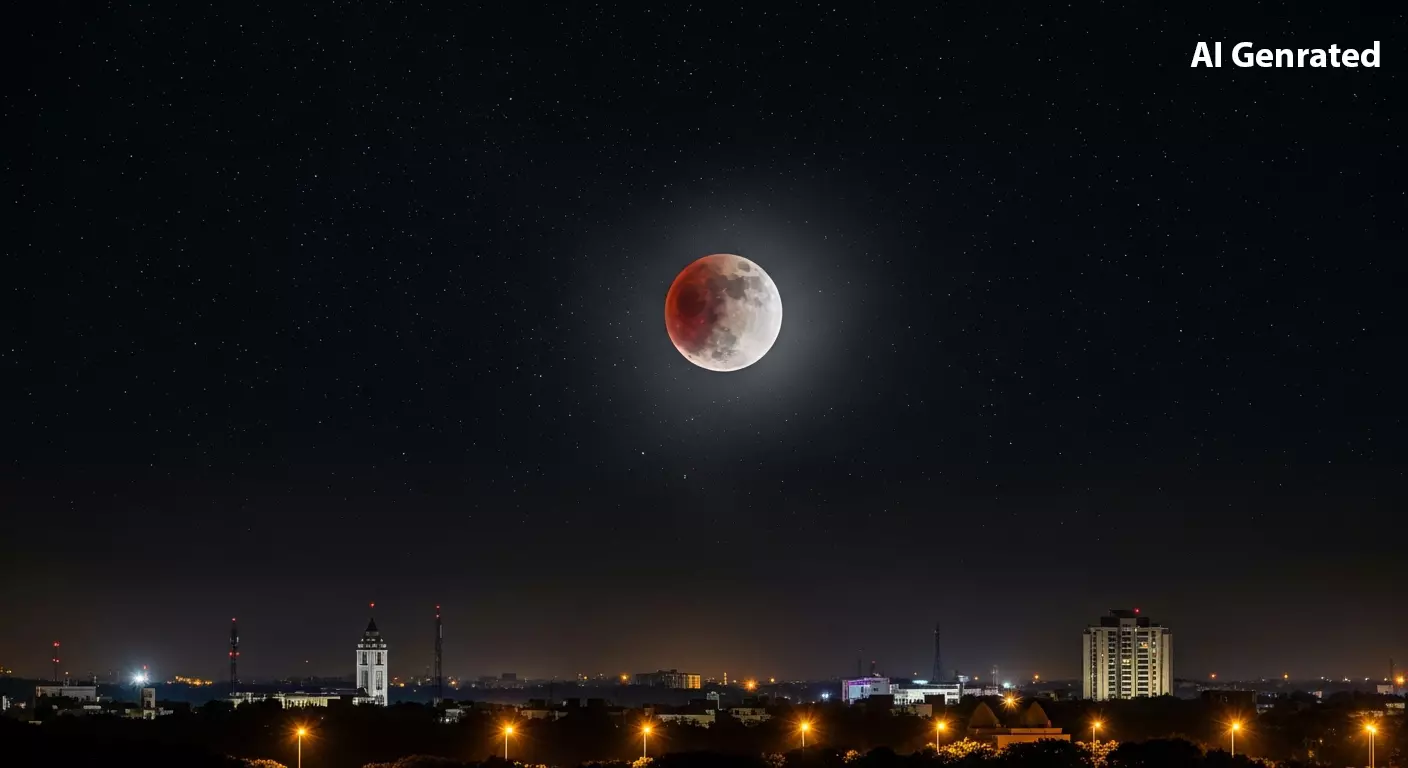
Rare Celestial Event Over Nagpur on 3 March
Residents of Nagpur will have the opportunity to observe a partial lunar eclipse on 3 March, with astronomical projections indicating that up to 30% of the Moon’s visible surface may fall under Earth’s shadow during the peak phase.
Unlike total lunar eclipses that turn the Moon reddish, this event will display a distinct dark arc gradually moving across the lunar disc. Weather permitting, the eclipse will be visible without special equipment, making it accessible to both astronomy enthusiasts and casual observers.
Understanding the Science Behind a Partial Lunar Eclipse
A lunar eclipse occurs when the Earth comes directly between the Sun and the Moon, casting a shadow on the lunar surface. However, in a partial eclipse:
- Only a portion of the Moon enters Earth’s umbra (the darkest part of the shadow).
- The remaining part stays within the penumbra (lighter outer shadow) or remains fully illuminated.
The result is a clearly visible curved shadow cutting across the Moon’s bright surface.
This alignment happens only during a Full Moon phase, but not every full moon results in an eclipse because the Moon’s orbit is slightly tilted relative to Earth’s orbit around the Sun.
Eclipse Phases: What Nagpur Residents Will Observe
The event will unfold in gradual stages:
- Penumbral Phase Begins – Subtle dimming that may not be easily noticeable.
- Partial Phase Begins – Earth’s dark umbral shadow starts covering the Moon.
- Maximum Eclipse – Around 30% of the Moon appears darkened.
- Shadow Retreat – The umbra slowly moves away.
- Eclipse Ends – Moon returns to full brightness.
The entire process typically spans several hours, offering extended viewing time.
Visibility Conditions in Nagpur
Nagpur’s geographical location allows favorable viewing if skies remain clear. Factors influencing visibility include:
- Cloud cover
- Urban light pollution
- Atmospheric clarity
- Viewing direction toward eastern or southeastern sky during moonrise or mid-sky positioning
Open terraces, rooftops, and areas outside dense city lighting will offer the best experience.
Why This Eclipse Matters Scientifically
Partial lunar eclipses are not just visual spectacles; they provide valuable insights into:
1. Earth’s Atmospheric Composition
As sunlight passes through Earth’s atmosphere before reaching the Moon, dust and particles influence shadow coloration.
2. Orbital Mechanics
Eclipses help refine calculations of the Earth-Moon orbital system.
3. Public Astronomy Engagement
Such events increase interest in space science, especially among students and amateur astronomers.
Cultural and Traditional Context in India
In India, lunar eclipses have traditionally been associated with mythological interpretations. Some communities observe fasting or avoid certain activities during eclipses.
However, scientifically, a lunar eclipse is a completely natural and predictable astronomical event. Unlike solar eclipses, it is entirely safe to watch with the naked eye.
Viewing Guide for 3 March Eclipse
To enhance your experience:
- Choose an open area with minimal artificial lighting.
- Use binoculars to observe finer shadow details.
- A small telescope can reveal the lunar craters under shadow contrast.
- Use tripod-mounted cameras for long-exposure photography.
- Monitor local weather forecasts for cloud conditions.
No protective eyewear is required.
Comparison: Partial vs Total Lunar Eclipse
| Feature | Partial Lunar Eclipse | Total Lunar Eclipse |
|---|---|---|
| Shadow Coverage | Portion of Moon | Entire Moon |
| Color Effect | Dark curved shadow | Reddish “Blood Moon” |
| Frequency | More common | Less frequent |
| Visual Drama | Moderate | Highly dramatic |
This 3 March event will offer a moderate but clearly visible shadow effect over Nagpur’s night sky.
Educational Opportunity for Nagpur
Schools, astronomy clubs, and science institutions in Nagpur may organize observation sessions. Events like these encourage hands-on learning and curiosity about space sciences.
The partial lunar eclipse provides a reminder of the dynamic movements within our solar system — visible directly from our own city.