

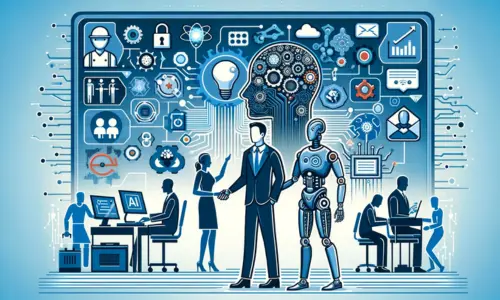
Artificial intelligence is no longer a future concept—it has become a daily workplace reality. In 2026, AI tools are reshaping how people work, learn, and build careers across industries. From automating repetitive tasks to enhancing decision-making and creativity, AI-powered technology is helping professionals achieve more in less time. As businesses adopt smarter systems and employees adapt to digital workflows, understanding the impact of AI tools is essential for anyone preparing for the future of work.
The rise of AI is not just about efficiency; it is redefining productivity, skill requirements, and career opportunities worldwide.
AI Is Automating Routine Work
One of the biggest transformations brought by AI tools is automation. Tasks that once required hours of manual effort—data entry, scheduling, report generation, and basic customer responses—can now be completed within minutes using intelligent systems.
This automation allows employees to:
- Focus on strategic and creative responsibilities
- Reduce repetitive workload
- Improve accuracy and efficiency
- Save valuable time for higher-value tasks
Instead of replacing workers entirely, automation is changing how time and skills are used in modern jobs.
Smarter Decision-Making With AI Insights
AI-powered analytics tools are helping professionals make faster and more informed decisions. Businesses now rely on AI to analyze large volumes of data, predict trends, and identify patterns that humans might miss.
For example, marketing teams use AI insights to understand customer behavior, while finance teams use predictive tools to manage risks and forecast growth. This data-driven approach improves planning, reduces uncertainty, and supports smarter strategies.
AI Is Enhancing Creativity and Productivity
Contrary to early fears, AI is not only technical—it is also supporting creativity. Writing assistants, design generators, coding helpers, and presentation tools are enabling professionals to produce high-quality work more efficiently.
Employees can now:
- Draft reports faster
- Generate design concepts quickly
- Improve communication clarity
- Speed up research and brainstorming
AI is becoming a collaborative partner rather than just a machine, helping individuals perform at a higher level.
Changing Skill Requirements for Future Careers
As AI tools become integrated into daily work, employers are increasingly valuing digital adaptability. Skills such as critical thinking, creativity, emotional intelligence, and technological literacy are becoming more important than routine technical knowledge alone.
Professionals who learn how to work alongside AI systems—understanding their strengths and limitations—gain a competitive advantage in the job market. Continuous learning, upskilling, and digital awareness are now essential career strategies.
AI Is Creating New Job Opportunities
While automation replaces some repetitive roles, it is also creating entirely new career paths. Fields such as AI operations, data analysis, automation management, digital strategy, and human-AI collaboration are expanding rapidly.
Companies need professionals who can:
- Manage AI-driven workflows
- Interpret automated insights
- Maintain ethical technology practices
- Integrate AI into business processes
This shift demonstrates that AI is not eliminating work—it is transforming it into more specialized and innovative roles.
Impact on Students and Young Professionals
Students entering the workforce in 2026 are preparing for careers where AI tools are standard. Learning how to use digital productivity platforms, automation software, and intelligent assistants is becoming part of career readiness.
Young professionals who develop adaptable skills, technological confidence, and problem-solving abilities are better positioned to succeed in this evolving environment.
Building a Balanced Human-AI Future
The most successful workplaces are not those that rely only on technology, but those that combine human creativity with AI efficiency. While machines excel at speed and data processing, humans remain essential for judgment, empathy, innovation, and leadership.
The future of work lies in collaboration between people and intelligent systems.
Conclusion
AI tools are transforming everyday work and careers in 2026 by automating routine tasks, improving decision-making, enhancing creativity, and creating new professional opportunities. Rather than replacing human talent, artificial intelligence is redefining how productivity and success are achieved.
Those who embrace AI, continuously upgrade their skills, and learn to collaborate with intelligent tools will be best prepared for the future workplace. In a rapidly evolving digital economy, adapting to AI is no longer optional—it is a crucial step toward long-term career growth.